© 2022 Zone. All rights reserved.

Interoperability Is More Than Connection: Five Layers of a Mature Payment Ecosystem
Published September 18, 2026
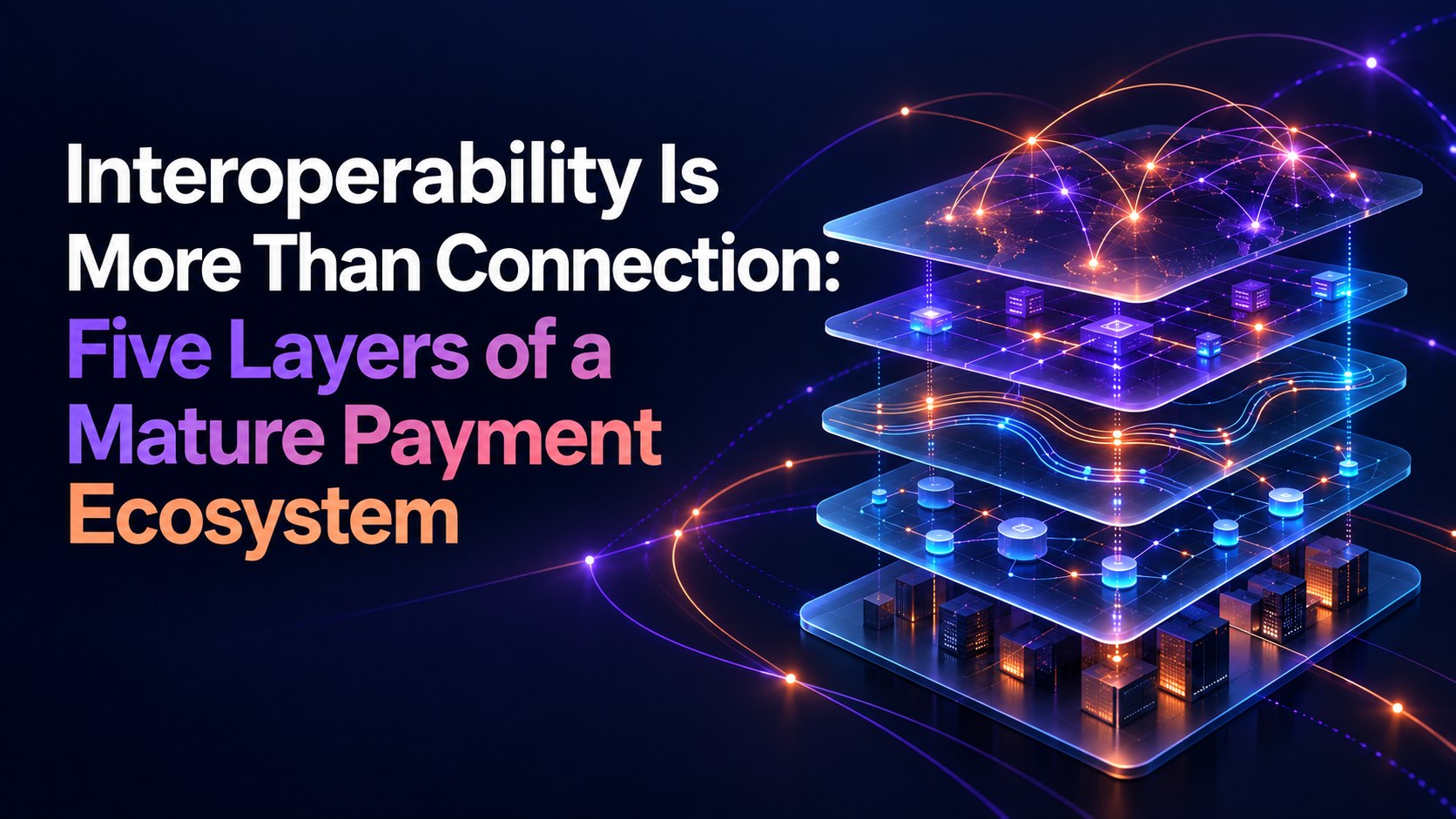
When people talk about payment interoperability, the conversation often stops at connection: can System A talk to System B? True interoperability, the kind that underpins a resilient, inclusive digital payments ecosystem, runs far deeper than technical linkage. A mature payment ecosystem is built on five interdependent layers: technical reach, shared meaning, operating rules, trust controls, and user-centred outcomes. Understanding how these layers work together is essential for anyone thinking seriously about financial infrastructure, cross-border payments, and the future of account-to-account (A2A) transactions.
Layer One: Technical Reach
Technical reach is the most visible layer; the APIs, switches, and network connections that allow messages to move between banks, fintechs, mobile money operators, and payment service providers. This is where most conversations about interoperability begin and, unfortunately, where many end. But connectivity alone doesn’t guarantee that a payment actually completes, settles, or reconciles correctly. Reach is necessary infrastructure, not a finished ecosystem.
Layer Two: Shared Meaning
Once systems can technically connect, they need to agree on what the data means. This is the layer of shared meaning: common message formats, standardized data fields, and consistent definitions of things like beneficiary details, transaction purpose codes, and currency conventions. Without this, two systems can exchange messages perfectly while misinterpreting critical information, a mismatch that shows up as failed transactions, reconciliation errors, or delayed settlement. Standards like ISO 20022 exist precisely to solve for this layer, giving disparate payment rails a common language.
Layer Three: Operating Rules
Technical reach and shared meaning tell systems how to talk. Operating rules tell them how to behave. This layer covers the governance frameworks, liability arrangements, dispute resolution mechanisms, and settlement timelines that participants agree to follow. Operating rules answer questions technology cannot: Who bears the cost when a transaction fails? What happens when a dispute arises between a sender and a receiving institution? How quickly must funds be made available? A payment ecosystem without clear operating rules is fragile, every edge case becomes a negotiation rather than a predictable process.
Layer Four: Trust Controls
Trust controls are the layer most closely tied to regulatory compliance and risk management. This includes identity verification, fraud monitoring, anti-money laundering (AML) checks, and the broader compliance architecture that allows institutions to extend trust to counterparties they may never interact with directly. In a genuinely interoperable ecosystem, trust cannot be assumed, it has to be engineered. Robust trust controls are what allow a payment to move confidently across institutional and, increasingly, national boundaries, particularly as cross-border and borderless payment corridors expand across the continent.
Layer Five: User-Centred Outcomes
The final and arguably most important, layer is the one users experience: Did the payment arrive? Was it fast? Was it affordable? Was the process transparent? All four preceding layers exist in service of this outcome. A payment ecosystem can have excellent technical reach, tidy data standards, sound operating rules, and rigorous trust controls, and still fail users if the end-to-end experience is slow, opaque, or expensive. User-centred outcomes are the ultimate measure of interoperability maturity everything else is infrastructure in support of that goal.
Why the Five Layers Must Work Together
The mistake many discussions make is treating interoperability as a single technical milestone rather than a maturity model. A payment ecosystem doesn’t become interoperable the moment two systems connect, it becomes interoperable when technical reach, shared meaning, operating rules, trust controls, and user-centred outcomes reinforce one another. Weakness in any single layer creates friction elsewhere: strong technical reach without operating rules produces uncertainty; robust trust controls without shared meaning produce reconciliation headaches; and none of it matters if the end user doesn’t experience a faster, cheaper, more reliable payment.
As conversations around financial inclusion, digital payments infrastructure, and borderless commerce continue to gain urgency, this five-layer lens offers a more complete framework for evaluating interoperability maturity whether the context is domestic real-time payments, regional payment corridors, or broader account-to-account ecosystems. Interoperability, properly understood, is not a switch that gets flipped. It is a discipline that spans technology, governance, trust, and above all the people the system is meant to serve.
Recent posts



Discover how Zone can help your institution.
Zone regulated by the Central bank of Nigeria and authorized to offer payment processing services.
Copyright © 2026, Zone.
12B Admiralty Way, Lekki Phase 1, Lagos State, Nigeria.

© 2026. Zone is a payment infrastructure company enabling payments and acceptance of regulated digital currencies through its regulated blockchain network; it is duly licensed by the Central Bank of Nigeria. Unauthorised reproduction or redistribution of copyrighted materials on this website and Zone's digital media pages is strictly prohibited. By clicking on some of the links above, you will leave Zone's website and be directed to a third-party website. The privacy practices of those third parties may differ from those of Zone. We recommend you review the privacy statements of those third-party websites, as Zone is not responsible for those third parties' privacy or security practices. Additional disclosures can be found in the resources section of our website.